The variable media paradigm pairs creators with museum and media consultants to imagine potential futures for works in ephemeral formats, including digital media, performances, and installations. The initiative aims to define each of these case studies in terms of medium-independent behaviors and to identify the best strategies for preserving work with the help of an interactive questionnaire.
Variable Media Questionnaire
free online
software
Try this unique tool
designed to help preserve ephemeral works...
Seeing Double
a variable media
exhibition
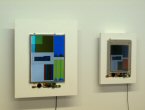
Guggenheim Museum
19 March - 16 May 2004
Learn
more about this groundbreaking exhibition...
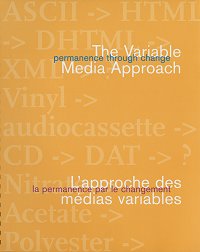
Permanence Through Change
a variable media
publication
 Download
 this publication...
For creators working in ephemeral formats who want posterity to experience their work more directly than through second-hand documentation or anecdote, the variable media paradigm encourages creators to define their work independently from medium so that the work can be translated once its current medium is obsolete.
This requires creators to envision acceptable forms their work might take in new mediums, and to pass on guidelines for recasting work in a new form once the original has expired.
Select an option at left to learn more about how this philosophy can be applied to specific cases.
| These are among the dozens of case studies examined by the Variable Media Network. |
| |
 |
Jan Dibbets
A White Wall, 1971. Photo collage.
more |
|
 |
Mark Napier
Net Flag, 2001. Web site.
more |
| |
 |
Ken Jacobs
Bitemporal Vision: The Sea, 1994. Film performance.
more |
|
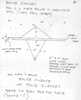 |
Bruce Nauman
False Silence, 1975. Audio installation.
more |
| |
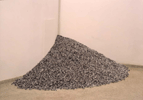 |
Felix Gonzalez-Torres
Untitled (Public Opinion), 1991. Interactive installation.
more |
|
 |
Nam June Paik
TV Garden, 1974. Video installation.
more |
| |
 |
Robert Morris
Site, 1964. Performance.
more |
|
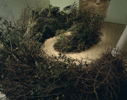 |
Meg Webster
Stick Spiral, 1986. Installation.
more |
| |
 |
Stan Douglas
Der Sandmann, 1995. Film installation. |
|
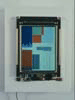 |
John F. Simon, Jr.
Color Panel v. 1.0, 1999. Digital sculpture. |
| |
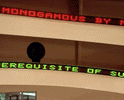 |
Jenny Holzer
Untitled (Selections from Truisms, ...), 1989. Electronic
installation. |
|
 |
Robert Smithson
Hotel Palenque, 1969. Slide installation. |
| |
 |
Grahame Weinbren and Roberta Friedman
The Erl King, 1982-85. Interactive video
installation. |
|
|
|
As its name suggests, the variable media approach looks for common denominators across different mediums.
Choose a link at left to see how artworks in very different mediums can exhibit the same behavior and provoke comparable preservation solutions.
| The variable media paradigm looks
at artworks not in terms of mutually exclusive technologies like film
or video, but in terms of overlapping medium-independent behaviors that
need to be preserved for the essence of the artwork to remain viewable.
To uncover these behaviors, it helps to compare artworks created
in entirely different mediums that present similar preservation
challenges. |
| |
 |
|
 |
| |
Meg Webster's
installation Stick Spiral (1986), bears no
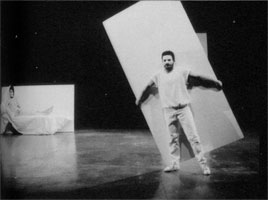
obvious resemblance to a performance such as Robert
Morris's Site (1964). Nevertheless, installing
Stick Spiral requires not merely re-creating the appearance of the original,
but also following a definite procedure—in this case filling a room with
recently cut branches from the nearby area pruned for a reason
other than the exhibition. In this sense, Webster's installation is
performed. While Site is performed by a male and female dancer manipulating plywood boards
and other props onstage, Stick Spiral is performed by curators and museum staff in
the act of gathering materials necessary to recreate the installation. Both works require
archiving instructions or a score for these
performances to be reenacted in the future—a shared behavior.
|
 |
|
 |
| |
In another comparison
of two artworks created in different mediums, Felix
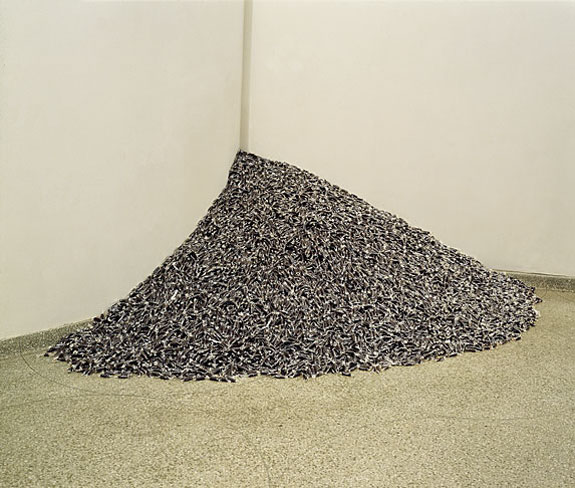
Gonzalez-Torres's Untitled (Public Opinion) (1991) would seeing
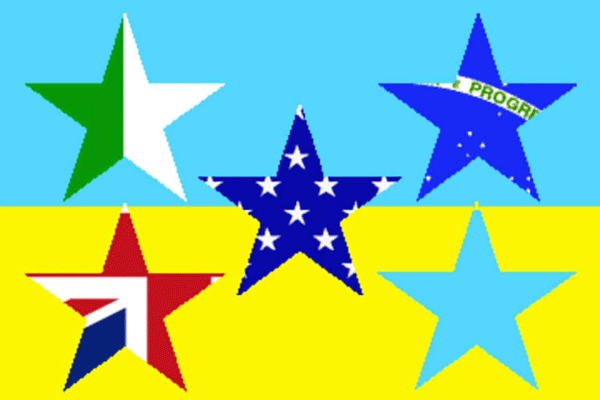
to have little in common with Mark Napier's net.flag (2001). The former is a candy spill in a museum, while the
latter is an image of a flag on a Web site. However, both works are based
on interchangeable parts: mass-produced commodities on the one hand and digital
files on the other. Both works are also meant to be interactive, since
visitors can take free candies from the Gonzalez-Torres and online visitors
can modify Napier's flag by adding or subtracting parts of flags of various
nations. Because of these similarities, re-creating these works will raise
similar questions, such as how to re-create the work once its technology
of duplication is obsolete and whether traces of previous visitors should
be erased or retained in future exhibitions of the work.
|
The variable media approach looks at creative works through some new lenses.
Choose a link at left to see a description of variable media behaviors (medium-independent attributes) or strategies (approaches to translating a work into the future).
| contained |
| In the variable media paradigm, even paintings
and sculptures can provoke prickly questions when some aspect of their
construction alters or requires an intervention. Such works are "contained"
within their materials or a protective framework that encloses or supports
the artistic material to be viewed. To account for these alterations in
otherwise stable mediums, the Variable Media Questionnaire asks questions
such as whether a protective coating is appropriate, whether surface qualities
such as brushwork or gloss are essential to the work, or whether an artist-made
frame can be replaced. |
| |
| Examples of contained
works |
|
Jan Dibbets
A White Wall, 1971. Photo collage.
more |
|
|
John F. Simon, Jr.
Color Panel v. 1.0, 1999. Digital sculpture. |
| |
| installed |
| For the purposes of variable media guidelines,
to say that a work must be "installed" implies that its
physical installation is more complex than simply hanging it on a nail.
Examples of artworks with this behavior are works that scale to fill a
given space or make use of unusual placement such as the exterior of a
building or a public plaza. For such works, the Variable Media Questionnaire
tracks issues of site-specific placement as well as scale, public access,
and lighting. |
| |
| Examples of installed
works |
|
Felix Gonzalez-Torres
Untitled (Public Opinion), 1991. Interactive installation.
more |
|
|
Nam June Paik
TV Garden, 1974. Video installation.
more |
| |
| performed |
| In the variable media paradigm, "performed"
works include not only dance, music, theater, and performance art, but
also works for which the process is as important as the product. For such
works, the Variable Media Questionnaire ascertains instructions that actors,
curators, or installers must follow to complete the work, in addition
to more conventional performance considerations such as cast, set, and
props. |
| |
| Examples of performed
works |
|
Robert Morris
Site, 1964. Performance.
more |
|
|
Meg Webster
Stick Spiral, 1986. Installation.
more |
| |
| interactive |
| While the word is most commonly applied
to electronic media such as computer-driven installations and Web sites,
interactivity also describes installations that allow visitors to manipulate
or take home components of a physical work. The Variable Media Questionnaire
tracks such considerations as the type of interface; the method by which
visitors modify the work; and the form in which traces of such input are
recorded. |
| |
| Examples of interactive
works |
|
Felix Gonzalez-Torres
Untitled (Public Opinion), 1991. Interactive installation.
more |
|
|
Mark Napier
Net Flag, 2001. Web site.
more |
| |
| reproduced |
| In the variable media paradigm, a recording
medium is "reproduced" if any copy of the original master of
the work results in a loss of quality. Such media include analog photography,
film, audio, and video. |
| |
| Examples of reproduced
works |
|
Stan Douglas
Der Sandmann, 1995. Film installation. |
|
|
Robert Smithson
Hotel Palenque, 1969. Slide installation. |
| |
| interchangeable |
| To say that some aspect of a work can be
interchangeable (also called "duplicated") implies that a copy could not be distinguished from the original
by an independent observer. This behavior applies to artifacts that can
be perfectly cloned, as in digital media, or to artifacts comprising readymade,
industrially fabricated, or mass-produced components. |
| |
| Examples of interchangeable
works |
|
Felix Gonzalez-Torres
Untitled (Public Opinion), 1991. Interactive installation.
more |
|
|
Jenny Holzer
Untitled (Selections from Truisms, ...), 1989. Electronic
installation. |
| |
| encoded |
| To say that a work is encoded implies that
part or all of it is written in computer code or some other language that
requires interpretation (eg. dance notation). In the case of works with
nondigital components, this code can sometimes be archived separately
from the work itself. |
| |
| Examples of encoded
works |
|
Jenny Holzer
Untitled (Selections from Truisms, ...), 1989. Electronic
installation. |
|
|
Mark Napier
Net Flag, 2001. Web site.
more |
| |
| networked |
| A networked work is designed to be
viewed on an electronic communication system, whether a Local Area Network
(LAN) or the Internet. Networked media include Web sites, e-mail, and
streaming audio and video. |
| |
| Examples of networked
works |
|
Mark Napier
Net Flag, 2001. Web site.
more |
|
|
|
The variable media paradigm allows creators to choose
from four strategies to tackle the obsolescence of a particular
medium, such as the bulbs of Dan Flavin's fluorescent light installations.
Storage
The most conservative collecting strategy-the default
strategy for most museums-is to store a work physically, whether that means
mothballing dedicated equipment or archiving digital files on disk. Storing
one of Flavin's fluorescent light installations simply means buying a supply
of the out-of-production bulbs and putting them in a crate. The major disadvantage
of storing obsolescent materials is that the work will expire once these
ephemeral materials cease to function.
Emulation
To emulate a work is to devise a way of imitating the original look
of the piece by completely different means. Emulating a Flavin fluorescent light
installation would require custom-building fluorescent bulbs that
produce the same light as and resemble the physical appearance of the original
bulbs. Possible disadvantages of emulation include prohibitive
expensive and inconsistency with the artist's intent. For example, Flavin
deliberately chose to use ordinary off-the-shelf components rather than esoteric
materials or techniques.
Migration
To migrate an work involves upgrading equipment and source material.
The obsolete fluorescent bulbs of Flavin's light installation could be upgraded to
fluorescent or halogen lights of comparable hue and brightness. The major
disadvantage of migration is the original appearance of the work will probably
change in its new medium. Even if state-of-the-art fixtures cast similar light to
Flavin's originals, the actual fixtures are likely to look different.
Reinterpretation
The most radical preservation strategy is to reinterpret the
work each time it is re-created. To reinterpret a Flavin light installation would
mean to ask what contemporary medium would have the metaphoric value of
fluorescent light in the 1960s. Reinterpretation is a dangerous technique when
not warranted by the artist, but it may be the only way to re-create performance, installation, or
networked art designed to vary with context.
The Variable Media Network has developed a number of resources to help advance the preservation of art in new and ephemeral media.
Choose a link at left to find out more about the variable media questionnaire or to download the latest variable media publication.
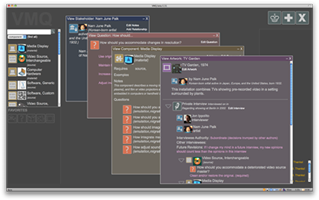 The Variable Media Questionnaire is an interactive form linked to a database and designed to assist creators and preservationists in writing variable media guidelines. The questionnaire is not intended to be exhaustive, but is intended to spur questions that must be answered in order to capture creators' desires about how to translate their work into new mediums once the work's original medium has expired.
Now available as a free Web service built by the Forging the Future alliance, the third-generation Questionnaire introduced a shift from the previous two versions by viewing the fundamental unit of an artwork as not the artwork itself, but the parts that are fundamental to its operation. In an attempt to capture as many impressions of the work as possible, questions about those components are posed to not just the artist whose name is on the wall next to the piece but also the curators, conservators, assistants, and even viewers who have experienced the work.
That said, the modern reality of art is that it is not enough to treat an artwork as just a collection of physical parts, and so the third-generation Questionnaire also recognizes environments, user interactions, motivating ideas, and external references as aspects to be surveyed and considered when preserving or recreating the piece. Expanding the scope of the data collected by the questionnaire often influences the way that artists, collectors, and scholars approach the artwork that it catalogues.
Permanence Through Change: The Variable Media Approach presents viewpoints, methods and case studies concerning the preservation of art created with non-traditional materials, tools and technologies. It includes texts by such authors as Bruce Sterling, Steve Dietz, Jon Ippolito, John Handhardt, and Nancy Spector, as well as excerpts from the 2001 "Preserving the Immaterial" conference.
Click
here to download all or part of this publication.
The Variable Media Network has organized numerous public and private events, most recently an exhibition and conference on emulation as a preservation strategy.
Choose a link at left to learn more about these events.
The exhibition
Seeing Double: Emulation in Theory and Practice, at the Guggenheim Museum from 19 March to 16 May 2004, pairs artworks in endangered mediums
side by side with their re-created doubles--and sometimes triples--in newer mediums,
offering visitors a unique opportunity to judge whether the emulated works capture the
spirit of the originals.
Click
here to learn more about this groundbreaking experiment.
Over the course of the
Seeing Double exhibition, the Guggenheim surveyed artists, preservation experts, and the general public to assess the success or failure of the re-creations on view.
"Echoes of Art: Emulation As a Preservation Strategy," a symposium offered on 8 May 2003 at the Guggenheim, divulges the results of this survey to stimulate a discussion about the role of emulation in keeping digital culture alive. Artists, programmers, conservators, curators, gamers, and intellectual property experts debate the merits of this approach and place the issues of technological obsolescence in a cultural context.
Click
here to read an interactive transcript of the conference.
"Preserving the Immaterial," a conference held at the Guggenheim in New York in March of 2001, was the
first public presentation about the variable media paradigm. Participants included artists Ken Jacobs, Robert Morris, Mark Napier, and Meg Webster as well as preservation specialists Jennifer Crowe, Steve Dietz, Jon Gartenberg, Richard Rinehart, Jeff Rothenberg, and Benjamin Weil.
Click
here to view an interactive transcript of this conference.
As its name suggests, the Variable Media Network is the result of many different individual and institutional contributions.
Choose a link at left to learn more about its participants.
Founding Members of the Variable Media Network include
Berkeley Art Museum/Pacific Film Archives, Berkeley
Franklin Furnace, New York
Guggenheim Museum, New York
Daniel Langlois Foundation for Art, Science, and Technology, Montreal
Performance Art Festival + Archives, Cleveland
Rhizome.org, New York
Walker Art Center, Minneapolis
The Variable Media Network is presently coordinated by:
Jon Ippolito, Associate Professor of New Media and Co-director, Still Water, The University of Maine; former Associate Curator of Media Arts, Solomon R. Guggenheim Museum;
Alain Depocas, Director of the Centre for Research and Documentation (CR+D), Daniel Langlois Foundation
Technical leads for the Variable Media Questionnaire have included:
Jon Ippolito: First-generation.
Alain Depocas: Second-generation.
John Bell: Third-generation.
Numerous artists, professionals, and consultants in various positions over time have participated
in the development of the Variable Media Network. They include
Bridget Alsdorf, Collections
Curatorial Assistant, Guggenheim Museum
Caroline Aubin, Curatorial
Intern, Guggenheim Museum
Julie Barten, Conservator, Exhibitions, Guggenheim Museum
John Bell, Senior Researcher, Still Water, University of Maine
Randolph Black, Registrar
for Collections Management, Guggenheim Museum
Bill Brand, independent film restorer and artist
Ann Butler, Archivist,
Guggenheim Museum
Paul Clay,
theatrical designer and visual artist
Jennifer Crowe, ArtBase Consultant, Rhizome.org
and Producer, EGG Online Thirteen/WNET New York
Steve Dietz, Director of New Media Initiatives,
Walker Art Center
Jon Gartenberg, independent film curator and
restoration specialist
John G. Hanhardt, Senior
Curator of Film and Media Arts, Guggenheim Museum
Susan Hapgood, Curator of Exhibitions, American
Federation of Arts
Jon Huffman, Representative, Nam June Paik Studio
Ken Jacobs, artist
Caitlin Jones, Daniel Langlois Variable Media Preservation Fellow at the Solomon R. Guggenheim Museum
Mona Jimenez, Interim Director, Independent Media
Arts Preservation (IMAP) and artist
Branden Joseph, Cotsen Fellow in the Princeton
Society of Fellows in the Liberal Arts, Princeton University
Paul Kuranko, Media Arts
Specialist, Guggenheim Museum
Pip Laurenson, Sculpture Conservator, The Tate
Gallery
Tiffany Ludwig, Producer of Virtual and Physical
Programs, Franklin Furnace
Starr McCaleb, Curatorial
Intern, Guggenheim Museum
Robert Morris, artist
Mark Napier, artist
Richard Rinehart, Digital Media Director, UC
Berkeley Art Museum and Art Department Faculty and Founding Member and Architect,
Conceptual and Intermedia Arts Online (CIAO)
Andrea Rosen, Executor, Felix Gonzalez-Torres
Estate
Nancy Spector, Curator
of Contemporary Art, Guggenheim Museum
Jeff Rothenberg, independent computer science
researcher
Blair Thurman, Representative, Nam June Paik
Studio
Bruce Sterling, science fiction writer and journalist
Carol Stringari, Senior
Conservator, Contemporary Art, Guggenheim Museum
Stacy Sumpman, Media Coordinator and Repertory
member, Cunningham Dance Foundation
Lynn Underwood, Director
of Archives, Library, and Museum Records, Guggenheim Museum
Stephen Vitiello, independent media curator and
artist
Meg Webster, artist
Benjamin Weil, Curator of Media Arts, San Francisco
Museum of Modern Art
Martha Wilson, Founding Director, Franklin Furnace
and member, Conceptual and Intermedia Art Online (CIAO)
The support of the following current and past Guggenheim staff has been critical to this project
Bridget Alsdorf, Collections Curatorial Assistant
Caroline Aubin, Curatorial Intern
Julie Barten, Conservator, Exhibitions
Randolph Black, Registrar for Collections Management
Ann Butler, Archivist
John G. Hanhardt, Senior Curator of Film and Media Arts
Paul Kuranko, Media Arts Specialist
Starr McCaleb, Curatorial Intern
Nancy Spector, Curator of Contemporary Art
Carol Stringari, Senior Conservator, Contemporary Art
Lynn Underwood, Director of Archives, Library, and Museum Records
Other participating Guggenheim staff
David Bleecker, Senior Education Program Manager
Susan Cross, Assistant Curator
Lisa Dennison, Collections Curator and Deputy Director
Deirdre Donahue, Librarian
Matthew Drutt, Associate Curator
Mara Guglielmi, Paper Conservator
Pablo Helguera, Education Program Coordinator
Victoria Holland, Assistant Theater Manager
Michael Lavin, Theater Director
Kevin Murphy, Administrative Assistant, Film and Media Arts
Eleanora Nagy, Sculpture Conservator
Fiona Ragheb, Associate Curator
Rajenda Roy, Program Manager, Film and Media Arts
Natasha Sigmund, Collections Registrar
Maria-Christina Villaseñior, Associate Curator, Film and Media Arts